Writing up knitting patterns is quite a challenging pursuit (at least I find it so, probably because my brain has been scrambled by 15 years of parenting). I’m sure though that there are plenty of talented designers that breeze through the process in a logical, structured and professional manner but for me it is a much more haphazard affair! Making finished items completely relaxes me and although I stitch count I don’t bother to count the rows, instead I knit until it looks the right length. But writing up a pattern for someone else to follow is a whole different kettle of fish – it needs to be precise in terms of both stitch and row counts, easy enough to follow and there is a lot of self-imposed pressure to get it perfect. I thought I’d use the recently released mouse pattern to give you a little insight into the way that I put my patterns together.
Luckily I’ve had the benefit of 8 years worth of making and tweaking most of my animal patterns and they’ve evolved as I’ve tried out different methods of increasing and decreasing, varying stitch counts, placement of shaping and so on. That however has meant that I have mixed up notes in different notebooks/paper scraps so my very first step is to collate my scribblings into some kind of chronological order. Next I type up my most recent notes, checking back through previous versions to make sure I’ve not missed anything.
Then it’s time for the first full knit through, ticking off each line as I go, clicking away with my row counter and making notes on anything that needs changing or clarifying. I’ll make up the finished animal and check that it looks as I’d intended – sometimes I’ll go back and add a couple of rows to a tail or change around some of the increases and decreases. On the mouse I did a fair bit of tweaking to get the nose shaping to be symmetrical which is fiddly as there is shaping at the nose (which is viewed right way up) and the underside of the chin (which is viewed up-side-down).
Once I’m happy with the pattern it’s time to sort out which yarns to use. I try and research lots of different yarns and work out which will be best suited to the pattern. In order to decide which yarns to shortlist for inclusion in the pattern I make a finished head in each potential yarn. For the mouse pattern I tested out a total of 12 different white DK and Worsted yarns and 5 different flesh coloured ear and tail yarns.
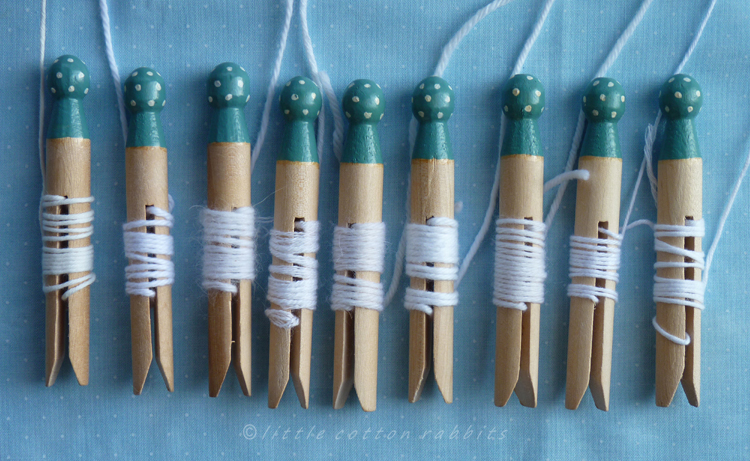
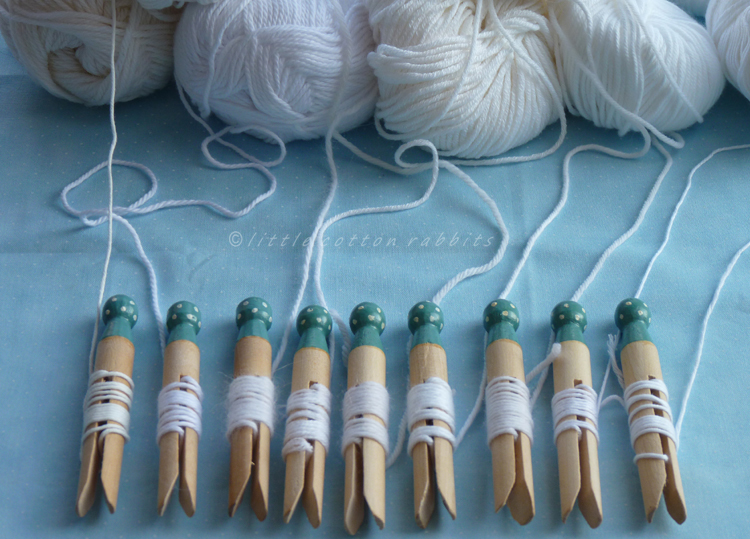
From left to right:
- Freedom Sincere Cotton DK, shade 600 (quite thin)
- King Cole cotton soft DK shade 710 (mid weight)*
- Adriafil Carezza classic (Aran) shade 02 (quite thin but fluffy) See note at bottom of post
- Debbie Bliss Mia shade 001 (mid weight)*
- Rowan Pure Wool Worsted shade 101 (mid weight)*
- Debbie Bliss cotton DK shade 13001 (thickest of all tested)
- Rowan Pure wool DK shade 012 (quite thin)
- Rowan Cotton Glace (DK) shade 726 (thinnest of all tested)
- Rowan Pima cotton DK shade 069 (quite thin)
I’ve made notes on the thickness of the yarn – simply put, the thinner yarns will result in a smaller finished animal. The asterisks * are used to show yarns I’d particularly recommend.
Other yarns that I’d recommend for mouse making include: Sublime baby cotton kapok DK shade 15; Cascade 220 shade 8505 (worsted) and a combination of Debbie Bliss Rialto DK shade 001 held with a strand of Debbie Bliss Angel shade 01.
At this point it’s interesting to compare the significant differences between yarns in the same weight classification. Below are two heads made with DK yarn, on the left Debbie Bliss Cotton DK and on the right Rowan Pure wool DK. They are both knitted to the same pattern on 3mm needles and stuffed to the same degree of firmness but there is a definite difference in finished size.
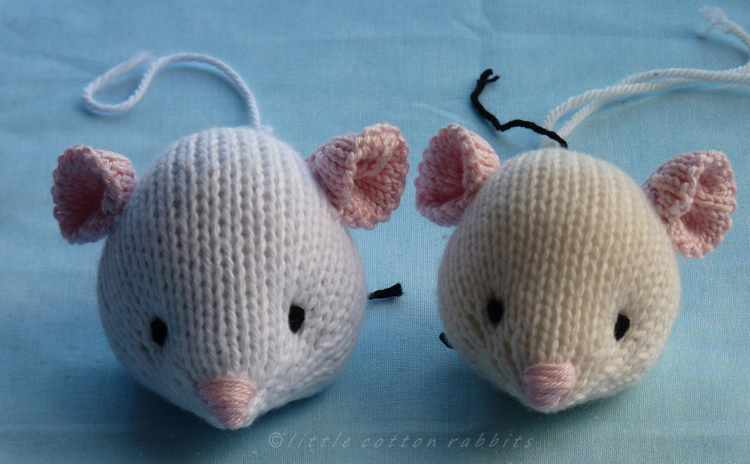
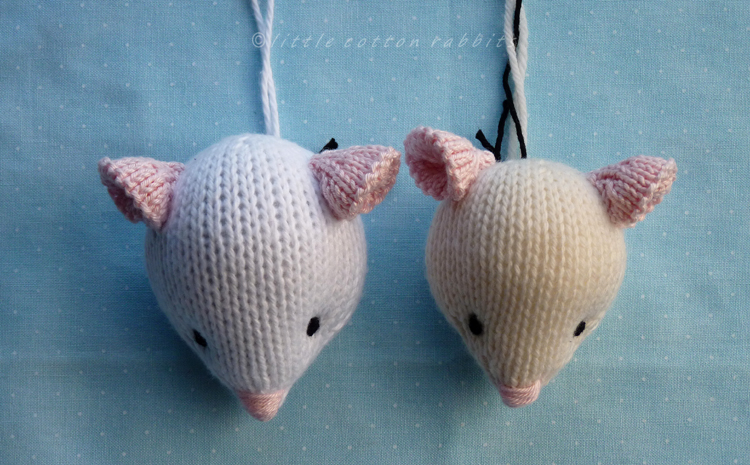
I’ve been asked a few times by people to give measurements for the finished heads (circumference, length etc) but you can see here how difficult that is for me to do. Throw in the variable of different knitting styles and tensions and it becomes impossible. The most important thing is that if you are the one doing all of the knitting throughout the pattern then everything should end up in proportion even if it is a little larger or smaller than someone else might make.
Next I work on the clothing patterns for sweaters and dresses and I often end up making at least 5 samples for each pattern. If I find a mistake as I’m working through each line in the pattern, I correct it, print off a new version and knit a new sample. When I’ve knitted one through with no mistakes and I know the pattern is correct I make several samples to test out different yarns and colour-ways for the clothing.
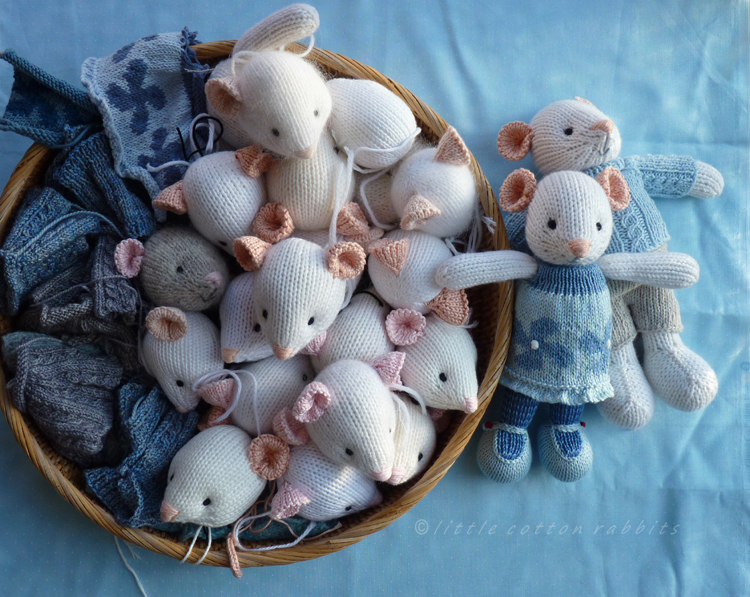
Once the yarns are finalised I make two full sets of animal parts and multiple parts for the step-by-step sequences ready for a photo shoot with H. We usually shoot the images for each pattern over a couple of days as it gets tiring bending over and moving things a millimetre here or there and it’s hot under the lighting. We take an average of 2 shots for any static items and 3 shots for each image with my hands in (that way we have plenty to choose from during editing) so there are typically around 160 images for each animal pattern. We edit these images together and I work on the basis that if H as a non knitter can work out what is going on in the image then it must be OK to use! Once we’ve selected our final set of images H processes them and I do any minor retouching of dust etc. Then I resize everything and compile my step-by-step sequences before dropping all of the finished images into the pattern document.
When all of the images are in place the pattern gets a final read through before being sent out to my trusty test knitters. They usually spot a few things that I’ve missed as it’s often easy to get a little pattern blinded. Hopefully once the test knitters have finished the pattern is all correct and ready to be turned into a pdf and uploaded. I always get very nervous on the first day of launching a new pattern, after all the time spent it can be hard to call it finished and put it out there. Happily pattern releasing usually goes smoothly and it’s always a thrill for me to see finished items starting to pop up on the ravelry project pages and know that people have enjoyed using the patterns.
Finally, I get to settle down for a bit of gentle, stress-free knitting (and as much mistake making as I like) before starting to think about the next pattern 🙂
………………………………………
A note about Angora yarn:
This information is shared with the sole aim of helping others make an informed choice of their own…
In December 2013 PETA released a graphic video which brought to light shocking cruelty in some of the angora producing industry. You can read a little about it here:
http://blog.loveknitting.com/angora-wool-is-it-cruel/
I’ve used angora based yarns to make a lot of my mice over the years and I have a fair bit in my stash. It is beautifully soft and perfect for fluffy mice but clearly there are now concerns about the ethics of producing angora yarn.
I cannot find anything on Adriafil’s website about the sourcing of their of Carezza angora yarn (which doesn’t necessarily mean it is not ethically sourced) but there are companies who stress their yarn is ethically produced, the most notable being Orkney Angoras (you can read on their site about how they source their yarn).
If you do not wish to use angora in light of this information there are alternatives such as brushed alpaca yarn or mixing a strand of thin mohair yarn (Rowan Kidsilk haze, Debbie Bliss Angel or Drops Kid silk) in with a strand of DK wool/alpaca based yarn to give a pleasing fluffiness.
Thanks to Lynsey for bringing this to my attention.


Hi there
Not sure if I am missing the link but cant seem to find the pattern for the little mice. Has this been released yet or still waiting to be released. I think they are adorable.
Many thanks
Judy Gush
LikeLike
Hi Judy, yes the pattern have been released. they are on Etsy or Ravelry:
http://www.ravelry.com/stores/little-cotton-rabbits
https://www.etsy.com/uk/shop/Littlecottonrabbits
Thanks x
LikeLike
I saw a portion of a video sometime ago, and the image is still stuck in my head. I am an animal lover and it just made me totally ill. I will never, ever use angora.
Love your little mice!! So cute, and nicely made.
LikeLike
Wow Julie, thank you for blogging about the detailed process you follow. Your creations are simply stunning, even hubby who will never get as excited about woolly things as me has to agree (when he’s been forced to look at yet another yarny blog and make all the right noises as I get excited about woolly creations). I didn’t know about the angora concerns, but will take Sandra’s word for it above and not seek out any images, I too am a complete animal lover and cannot bear cruelty of any kind. Thank you for bringing this to my attention. Lil x
LikeLike
Julie your work is utterly sublime in every way. Oh that basket of clothes and little mice – it actually makes my heart beat faster !
Have a great rest of week,
Kate xx
LikeLike
With all that work involved you should charge more for your patterns. I do not think people realise. Well done.
LikeLike
those mice are so cute!! and thank you for mentioning about ethically sourced angora, I don’t buy anything with angora in it because of the cruelty involved, but knowing that there is a great source for ethical angora yarn, I’m going to reconsider. Thanks again!
LikeLike
I’d not recommend viewing the video to anyone who is sensitive – it is not necessary to view the suffering in order to understand that there is an issue but I’d definitely recommend reading the Love Knitting article which is an excellent unbiased and rational discussion of the issues.
LikeLike
Wow. What a lot of hard work goes into producing a pattern. I think they are all lovely whatever yarn they are worked in. Well done.
LikeLike
I admire you and your work! I have purchased 4 of your patterns and I love using them, and I always love the end product!I am always proud to gift them to my family and friends. I think it will take many years, but I aspire to knit like you someday :). Your patterns are the best written patterns I have ever purchased.
LikeLike
Hi Julie, I truly enjoyed reading your explanation on pattern writing, a lot of work goes into this, and as we all know you are a perfectionist a truly talented lady, who designs and makes the most wonderful , cute, and oh so gorgeous wee animals ever 🙂
Will you be releasing a special toy pattern for Christmas ? love to you and your family xx
LikeLike
The little meece! So gorgeous! Having followed many of your patterns over the years, I know that they are always, always easy to follow – and any shortcomings in the final product are definitely down to my own knitting abilities 😉 The faces on your little creatures are utterly irresistible!
LikeLike
I am so glad you do take the time to write these patterns out for us, they are just so beautiful.
LikeLike
I am so glad you do take the time to write these patterns out for us, they are just so beautiful.
LikeLike
I am so glad you do take the time to write these patterns out for us, they are just so beautiful.
LikeLike
I am so glad you do take the time to write these patterns out for us, they are just so beautiful.
LikeLike
I am so glad you do take the time to write these patterns out for us, they are just so beautiful.
LikeLike
I am so glad you do take the time to write these patterns out for us, they are just so beautiful.
LikeLike
I am so glad you do take the time to write these patterns out for us, they are just so beautiful.
LikeLike
I am so glad you do take the time to write these patterns out for us, they are just so beautiful.
LikeLike
I am so glad you do take the time to write these patterns out for us, they are just so beautiful.
LikeLike
Great post Julie. As someone who creates knitted hat patterns for babies and toddlers I really now know the time and effort that it takes to create a pattern. It seems we work very similarly. Years of scrapped up notes for each hat that I always understood and then trying to put it into some logical order for someone else is always a challenge. I guess the only difference is with my complete lack of computer skills, I employ someone to do all my typing and layout and it works well.
I’ve purchased some of your patterns and have loved knitting them up, they’re perfect and precise and lots of photos are always a plus…..and I’ve been told that as well with the feedback I’ve received from mine.
So well done, the only thing that bothers me about you and your patterns, is how quickly you can get them out, especially knowing your commitment to your family, so well done, I’m slightly green!!!!….I live in hope that I’ll have my fourth pattern out by Christmas…time permitting.
Many thanks for the insight. Vicki x
LikeLike
Dear Julie,
You are amazing and this thorough post was just fascinating. Bravo for getting it all down and thank you for shedding light on your method of pattern writing.
And now I defy anyone who does not rush off to make an adorable white mouse!
LikeLike
Thank you for a wonderful tour through your pattern writing process…and how difficult it is to “standardize” a pattern. I have a sweater pattern in timeout because I have knit four sleeves (with the same yarn and needles) and have ended up with four sleeves of wildly different sizes due to my mood at the time of knitting.
Loved the article about PETA. Their headquarters is not far from where I live…and some of their staff has been less than ethical. They dumped euthanized dogs in a dumpster in the region on several occasions. When they were a young organization, they used to come to local dog shows, hand out pamphlets and collect funds…until some of the people who got the pamphlets realized that they were actively promoting not owning pet dogs and definitely not show dogs.
If you look (and/or if you spin), you can buy angora fiber/yarn directly from the bunny’s owner…and many will be happy to show you how their bunnies are kept. The only time I have ever felt bad for the rabbits is at one of our regional yarn shows…and then it was a question of how hot and humid it was…not the manner of the rabbit’s husbandry (though it is so cool to see angora spun directly off the rabbit).
LikeLike
Those mice are too darn cute. Thank you for taking the time to explain your work. I admire your patience to do all of this so we have too cute patterns to knit. Off to find the mice pattern.
LikeLike
You are so talented and I fully admire what you do here and in your home, truly a remarkable
lady ☺☺
LikeLike
A fascinating insight into all of the work that goes into your beautiful patterns. CJ xx
LikeLike
Thanks for the info on the angora yarn. The mice are adorable, almost as adorable are the rabbits that are my favorite. You are truly gifted, thanks for sharing!
LikeLike
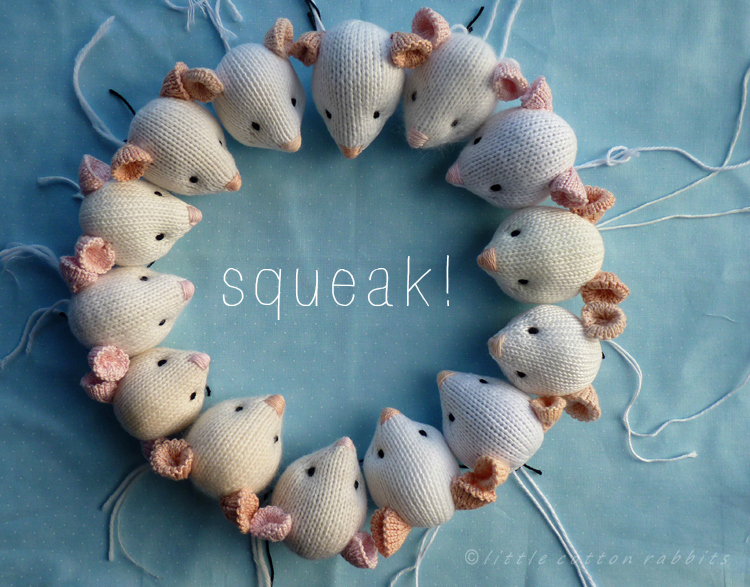
What a tremendous amount of work goes into to producing a pattern, I have to be honest writing a pattern terrifies me! I absolutely love your squeak photo, your little mice are gorgeous! 🙂
I have really been put off using angora since all the cruelty came to light, I’m sure there is lots of angora produced where the little creatures aren’t mistreated in any way but we certainly need more information ! I just couldn’t bare to think of a little rabbit suffering!!
V x
LikeLike
Julie, I’ve loved your animals for years and am quite proud that I was lucky enough to score one made by you and was so excited when you began to release patterns for them.
I think of your pattern writing and editing might be similar to trying to learn how my mom made certain dishes. No recipes, or if there were, there were scribbled notes on the side that could only be interpreted by her. Once I called her to ask how to make something and I remember her saying “Add the flour until it looks right”. As if I had a clue as to what it was supposed to look like. 🙂
Thank you for all the work and attention given to each of your creations, and the patterns that will help us make mere imitations
LikeLike
Dear Julie,
I just happened upon your site as I was about to login to my typepad blog. OMG! How wonderful are your designs. They make me want to try knitting again. I have a 6 mo. old great grandniece and if I could make her one of your adorable critters, I think it would be cherished. Thank you for sharing your creativity!
LikeLike
I loved reading about your process. I too have written and sold my own original patterns and realize just how much work goes into producing an easily understood pattern. I must say you definitely go above and beyond the standard. Your patterns are such a value for the amount of information you give. I appreciate that you leave nothing out. There are no secret techniques that are held back. Generous in every way, you have produced patterns that are easy to follow and even more easy to love.
Thanks again for sharing your amazing talent with all of us.
LikeLike
Am even more in awe of your talent, commitment and work ethic… You are an absolute genius and brighten up my world.
LikeLike
You are so kind to release these patterns I am sure they bring joy to many people which makes all your hard work worth it. I am off to buy my pattern today x
LikeLike
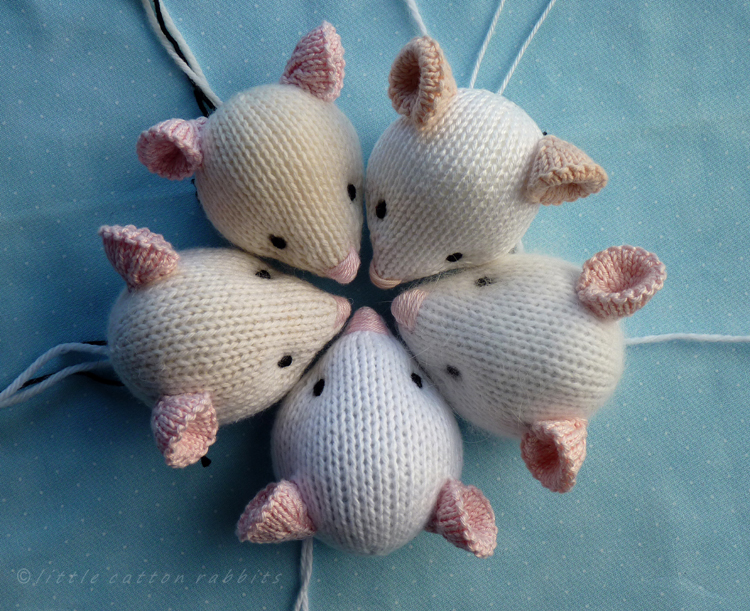
A great photo of all those mice heads in a circle, It enticed me to click through and read.
LikeLike
Actually i love the way you stage all your photographs, they are lovely.
LikeLike
This was a great post about your creative process. I particularly liked the yarn comparisons. I must get on with a mouse. The rabbit I made is still with the friends granddaughter in Thailand and very loved.
LikeLike
It’s so interesting to read about your pattern creating process. It certainly involves a lot of work. I have written up patterns for myself so I can repeat something I’ve made and liked. I don’t add pictures – just the knitting instructions – and that is hard enough to get right.
LikeLike
I don’t know how you find time to do this Julie with a family to look after and Toby’s extra special needs, it is clearly a labour of love as well as a way of usefuloutlet for creativity/productivity & sanity preservation. Thank you for it all xxx
LikeLike
These are so beautiful – just like all your wonderful creations. Alas, I cannot knit – crochet, yes – knit, non. I may have to give learning another go if it means I can make something like these 🙂
LikeLike
you work very hard julie,but your pattens bring so much joy to everyone,have a good rest now. (he he but can not wait for next one i so love them.)
.
LikeLike
It’s wonderful that you make the time to share something that you are so passionate about. Your animals are darling. Just darling. Being able to join you in knitting them is a real treat. Thank you! 🙂
LikeLike
I appreciate every moment, every picture, every detail examined under a magnifying glass and the love you pour into these wonderful patterns. If you were in our school system you would be a “Level 5”!!!!! I own and have made all of your patterns…except the new little mice….and every pattern teaches me, guides me and more importantly inspires me! I have a pretty busy life, three sons the youngest has special needs and I also have my “Little Cotton Rabbit World” that I love to wander in, relax and create and I have you to thank for that. The pleasure I derive from the knitting, stitching, stuffing, sourcing yarn and more recently sourcing the perfect little buttons is priceless. In this busy world it is lovely to slow down and enjoy the moment. Thank you for your generous sharing 🐭🐰🐘 fox ……🐷??
Fondly, Lori from Port Perry
LikeLike
What an intersting post Julie. So much work goes into your patterns and I hope some of the folks always asking for more (often at such short notice…like patterns for Christmas) read this and appreciate what you have already given so generously. xx
LikeLike
Thanks for the great insight into pattern writing and how you do it. I think the time you spend shows in your patterns which are literally step by step for knitters. I look forward to each release you make and can’t wait for the next one to come out. (i’m hoping for a bear or a monkey):-)
LikeLike
Dear Julie, first of all I have to say I love your patterns! And next, I’m a hand spinner. I work with raw wools and and angora. I have many friends who have, rabbits, Sheep, alpaca and goats. Many of my 30+ farmer friends were outraged at that video. Angry because they care and love their flocks and prize winning bunnies. Many of my friends have concluded that this was staged by PETA. You see, people who raise animals for a living would not cause harm to an animal because of all the time and money it takes to get an animal to the point of harvesting the fiber. If you injure an animal, it will get sick and die. Surely a business or farm would not be able to sustain itself if it injured it’s animals. If you injure a blue ribbon bunny, you can’t show it. Is there abuse? Yes, sometimes there is an idiot now and then but shearers put their name on the line. Word of mouth is what keeps them successful. So please do not fear buying wools, angora, mohair etcetera. If you don’t buy wool, these endangered breeds and their wools they will go away forever. But dont just trust me, Get to know your local farmers and alpaca ranches. They will have shearing days that you can come see and join. See for yourself and get informed! There are different breeds of rabbits. The angora is a bunny that sheds or “Blows out” it’s fiber. All the owners do is comb it and put it in bags and collect it. Other breeds need to be clipped. This must be done or a rabbit can “Wool block.” But just like a cat with long hair, long hair rabbits need to be brushed and groomed daily or matts will occur.
LikeLike
The sad thing about the PETA campaign is that it tars everyone with the same brush but there are some very responsible, caring and ethical producers of angora yarn out there.
LikeLike
Love the mice! They are absolutely adorable.
I have no idea, Julie, how you manage to fit so much in during those 6/7 hours of school, which fly by so quickly… or how you remember the next day where you were up to!
Plenty of rabbit fur in my vacuum container, from my 2 houserabbits if anyone’s interested?!!
LikeLike
Hi Julie; I have emailed Adriafil asking them where they source their angora and the process. I will let you know when I hear back.
Lori from Port Perry
LikeLike
Your organization just astounds me, and…makes me feel quite inadequate. Thank you so very much for sharing your skills, knowledge & wisdom with the rest of us. I appreciate your blog & patterns more than you could ever know. Always best wishes for you, your knitting, and your family.
LikeLike
I think you are truly amazing!! Your animals are beautiful, I have some of your patterns but am too nervous to try in case my doesn’t turn out as lovely as yours is!! Keep it up!
LikeLike
Sin ninguna duda, los mejores patrones !!!!!
Me encanta tejerlos, disfruto muchísimo.
No me cansaré nunca de dar las gracias por tan buenos y largos momentos de traducir o interpretar o imaginar lo que quiere decir.
Para las que no entendemos su idioma, las fotografías nos ayudan muchísimo.
Así que de nuevo, gracias, gracias y gracias, para H tambien.
Without a doubt, the best skippers !!!!!
I love to knit them, I really enjoy.
I will never tire of giving thanks for such good and long time to translate or interpret or imagine what you mean.
For those who do not understand their language, the pictures help us a lot.
So again, thank you and thank you for H too.
LikeLike
Now that I have seen the mice heads in that circle at the beginning, I think you should make a MOUSE WREATH!! How about it? A few green leaves for some colour, a slice or two of Swiss cheese as a filler! (Okay, clearly I need to get out more! lol)
LikeLike
Julie, Thank you for sharing the process of pattern writing for your delightful animals.
I am quite bowled over by the exactitude of the process and think you should be charging way more!!!
Very much looking forward to beginning my first rabbit with your lovely pattern for a new grandchild.
Many thanks
Helen
LikeLike
oh how I love your mice x
LikeLike
Hello….See below the response I got fro Adriafil. More information to consider. I did order the Ardriafil carezza as suggested by Julie and feel somewhat better with their response.
Lori
Dear Lori,
thank you for your email and for your interest in our yarns.
Recently the PETA campaign has shocked Europe reporting cruel treatments on angora rabbits in China. Unfortunately this campaign is generalizing too much..
Adriafil, a solid company from 1911, takes personally this cause and desires to reassure its customers about the origin of his pure angora. Most of the angora rabbits of Adriafil are bred in France, just few of them in China. Our company counts on reliable partners who carefully and constantly inspect rabbits treatment in breedings. Suppliers regularly issue specific certificates proving that all the procedures are followed according to human sensitivity and laws in force.
Generally there are two forms of getting the angora fibre: one is shearing with scissors or machines and the other way is the hand plucking method.
The shearing by scissors can be done whenever thought to be necessary, here in Europe after 90 days, in China after 70/80 days in winter times or 50/60 in summer period (depending on climatic conditions). Most of the farmers treat their rabbits well simply because are an important source of income for them. We would like also specify that 90/95% of the Chinese angora rabbits are of the German type, so the one to be shorn by scissors.
The other rabbits are of the “Spicky type” with long coarse hair, especially raised in France. The hair of this rabbit usually is plucked by hand but there is one important thing to be taken notice: the time of growth of the hair has to be 120 days, because after 90 days the hair starts to loosen and it can be pulled out easily.
Choice of raw material as well as the processing techniques are followed in detail by Adriafil. We are confident to supply good quality material always in respect of all human beings and animals rights.
Kind regards,
Isabella
ADRIAFIL
LikeLike
Fascinating post!
Julie, have you come across the Bigwigs Angora yarns – http://www.bigwigsangora.co.uk/ – they are totally ethical and very, very gorgeous.
LikeLike
Thank you both for caring to bring us all such beautiful patterns. I used to buy angora from a reputable source but the lady had difficulty in finding a mill to spin such small amounts (and she wasn’t able to spin it herself), so she stopped producing the yarn. I had no idea it would be produced unethically (also alpaca which I buy loads of). Thanks for drawing this to my attention I will certainly be checking my sources in future. Thanks also to those who have mentioned good sources to check out. Going now – off to Ravelry buying meece patterns yippee!!
LikeLike
Julie, thank you for raisimg the issue of the ethical treatment of the animals from which our fibres are sourced. This is such an important issue and it is our responsibility as consumers of animal fibre to expect and demand that these animals are raised in an ethical manner.
If we all as crafters in fibre art make all attempts to source fibre produced in an ethical manner then we all can continue to pursue our craft with a clear and peaceful conscience.
Thank you also Julie for sharing not only your amazing talent but also your life with us.
Carol
LikeLike
Thanks so much for all the time and care you put into pattern writing! I had no idea how much time and work was involved in the process- I enjoy and appreciate your beautiful creations even more now that I know what is involved. And if loving your beautiful animals more than I already do is even possible! 🙂
Thanks for sharing!
LikeLike
Hi Julie I have also tried to find the pattern for the mice (which are lovely)but have been unable to find it what am I doing wrong to not be able to find it thank you.
LikeLike
these mouses are adorable!!!!! I want to follow your blog but I do not see where to plug … it is the cutest ever!! xoxo
LikeLike
thank Julie for sharing the link… I wonder if you’ve talked about sheep who also suffer greatly when being shorn. PETA has a very disturbing video about it also… I think its really important to treat animals with respect and offer them a good life and I think as knitters, we have a responsibility to be informed (and to inform others as well) about ethically sourced wool, be it rabbit, sheep, alpaca etc! Keep up the great work and thanks again for spreading the word!
LikeLike
I too would like the pattern for those tiny mice. Did you ever find it?
LikeLike
I too would like the pattern for those little mice. Did you ever find it?
LikeLike
All of my patterns (including the mice are here:
https://www.etsy.com/uk/shop/Littlecottonrabbits
J x
LikeLike
I really enjoyed reading about the process of writing your patterns. Looking forward to making some of your gorgeous animals soon.
LikeLike
No wonder your patterns are so amazingly detailed! Just started my first little mouse. Thank you for all your hard work x
LikeLike