crafts & knitting · new patterns

New Patterns: The Squirrels


It makes me very happy today to pop in here with news that my latest 9 inch animal pattern is ready to share. This is a pattern for a squirrel, which you can either make as a red squirrel with little tufty ears, or a grey squirrel without tufts.

As usual with my patterns there are 2 options: one for a squirrel in a removable dress with knitted on shoes and tights; and one for a squirrel in a removable sweater and shorts.

The squirrel in a dress pattern comes with these 3 dress options:

There is one that is worked in a single colour and has an openwork textured design, reminiscent of acorns. And two colour-work dresses, one with a bold acorn and oakleaf design that wraps around the lower skirt and the other that has a contrast coloured border dotted with small acorns.


The squirrel in a sweater pattern comes with these 3 sweater options.

There’s a plain stocking stitch sweater, knitted in a single colour and then a large acorn colour-work design is added in duplicate stitch afterwards. There is a chart for this in the pattern, and if you prefer you could choose to follow this and use the intarsia method to knit in the acorn design as you go.

There are also two textured sweaters, one a very simple knit and purl textured pattern, and the other a little more complex and with a bolder texture created by a combination of double increases and decreases.

Also included are a pair of shorts that have a functional button closure at the waist in order to accommodate the large tail.


Both patterns are now live on Ravelry and Etsy and because I recently had a small price increase (the first in 12 years) I’ve also increased the discount for buying any 2 or more LCR patterns in the same transaction to a 20% discount on the basket total. Mentioning it in case you wanted to get any of my other patterns at the same time in order to get the 20% off.

As always I am really excited to see what other people make with these new patterns, so if you do give either of them a go please do consider sharing a picture on social media or on either the Little Cotton Rabbits Facebook Group or the Ravelry group, I’d love to see what you’ve made.

Well I’m off to finish a couple of grey squirrels, because only their heads made it in to the pattern so I’m feeling a bit sorry for them, ’til next time keep well and happy, J x

…………………………………………………….

A little note on purchasing:

Ravelry have a really efficient and easy to use email delivery system of the download links and it is very rare that customers have any issues, (the vast majority of the issues that do occur are down to buyer input errors of email addresses).

If you choose to purchase via Ravelry I will actually get to keep a little more of the money that you pay for the pattern (Etsy seller fees are much higher than ravelry and I have to pay them at least a quarter every single sale, and almost double that if you click on an Etsy ad for my shop on google or pinterest, as they will then also charge me an advertising fee on anything you purchase from my Etsy shop anytime in the next month, even if you are an existing customer of mine).

If you do choose to use Etsy then please, please, please don’t check out as a guest, because if you do not receive the emailed link that they automatically send it is almost impossible for me to help you. Instead log in to an Etsy account first, and that way it is very easy for me to help if you have any problems as the files will be stored forever for you in your Etsy purchase history. And remember that Etsy do not allow you to download any digital purchases via the app, so you will need to log into your account via your browser to access files.


countryside · crafts & knitting · in the woods · wildlife

June: dog roses, daisies and dragonflies


Many of the places where Toby and I take our weekly walks are designated nature reserves, and so are a haven to all kinds of wildlife, from tiny insects and invertebrates, right up to large mammals such as badgers and deer. One of the best things about walking most days is the chance to see the different species that come with the changing seasons, and in June summer has arrived with us. Within the hedgerows and all along the path margins there is now verdant growth, and it seems that every leaf is home to some small creature; all manner of insect larvae, caterpillars, beetles, flies, bees and spiders. I carry my secateurs on all of our walks, though perhaps a machete would be more appropriate as our familiar pathways are frequently overgrown by new growth since the previous week and we trim our way through again. I’m constantly saying ‘careful, stingers’ and ‘mind the prickles’ to Toby so that he doesn’t brush against the stinging nettles or snag himself on the brambles and wild roses that continually encroach on our route.

The beginning of June was cool and green and usually this month is the segue between spring and summer, but this year there was no gentle transition and the full force of summer heat quickly arrived. Now at the end of June the countryside is beginning to look parched and I’m hoping that some rain arrives with us soon. We’ve had it forecast a couple of times, but it seems to evaporate on it’s way across the country before reaching this south east corner. We could do with some good old English summer weather, ie. torrential rain ๐Ÿ™‚

Knitting is not something that I enjoy much in weather this hot, but I have been making good progress on my new 9 inch animal and the patterns have just gone out to be tested with a lovely group of people who are likely to be a lot better at error spotting than I am right now – towards the end of a pattern you tend to be blind to the mistakes that you know are in there somewhere. Anyway, as it will be ready in the next couple of weeks I thought it was time to reveal what I’ve been working on, so first a clue in the form of a riddle…

Red or grey or rare times black,

tail curled across my back,

storing nuts for winter time,

in a treetop home to where I climb.

and then a picture…

(and yes, that is a basket full of failed tails, 19 of them!)

I’ll post full details as soon as the patterns have been fully checked and are ready to share, ’til then I hope you have a good couple of weeks where you are, J x


Nature notes from June:

  • Week 1: Some of the hedgerows at Panshanger are being decimated by ermine moth caterpillars, many thousands of them congregate, eat all the leaves and weave their webs, completely covering some of the trees. The webs are amazingly thick and strong and look devastating to the tree, but once the caterpillars pupate they will recover and regrow leaves.
  • Week 2: Dog rose, daisies and cow parsley are everywhere, simple beauty and a magnet for bees, beetles and hoverflies
  • Week 3: Out in the woods there are insects everywhere you look, nature is a marvel, also spotted some summer fungi on a tree
  • Week 4: This week has been the hottest so far, too hot to sleep well at night and the constant sun is parching the woods and countryside. All of the streams and brooks that run through the woods are now completely dry, and I look through the exposed pebbles on the stream bed for hag stones


crafts & knitting · knitting tips

Knitted increase methods for LCR Patterns

This is a post that I’ve been planning to write for a good long while. It details the increase methods most used in my range of Little Cotton Rabbits patterns, with pictures for each method and details of their specific characteristics so that they can be compared and contrasted. If you would like a copy to download and print there’s a free PDF file here.

A comparison of increases:

The table above compares six paired and mirrored increases. As you can see they are grouped vertically according to the direction in which the increase stitch leans (either to the left or to the right) and also grouped horizontally as matched symmetrical pairs which mirror each other.

All of the left leaning increases above can be substituted for each other without having to adjust the written pattern. This is because they are all made in the space between two existing stitches. The exact same goes for all of the right leaning increases. However, because each of these increase methods have a different impact on the stitches around them it is worth taking the time to understand the characteristics of each when deciding which will make the best substitute.

Below is a piece of knitting that compares the three left leaning increases detailed above, showing the impact that each of these increases has on the rows above and below it.

All three left leaning increase stitches are made on the blue row in the centre of the work. You can see how:

A: M1A impacts the row that the increase is made on, and creates the first full stitch on the pink row above
B: M1L impacts the row directly below in gold, and creates the first full stitch on the current row
C: KLL impacts and distorts the 2 rows below in pale yellow and gold, and creates the first full stitch on the current row

If you are making the increases in a pattern of lateral colour change stripes you will want to consider whether you start the stripes on the row prior to the increases or on the increase row itself as your stripes will either have neat transitional lines or steps depending on which of the increase methods you choose to use and where you place them.

. . . . . . . . . . . . . . . . . . . . . . . . . . . . . . . . . . . . . . . . . . . . . . . . . . . . . . . . . . . .

Left Leaning Increases:

KLL: Knit Left Loop (also known as LLI: Left Lifted Increase):

Method: Knit into the left leg of the stitch two rows below the stitch you have just worked by inserting the tip of left needle into the stitch from behind and bringing the loop onto the left needle. Insert the tip of the right needle into the back of the loop and knit, so making an extra stitch.

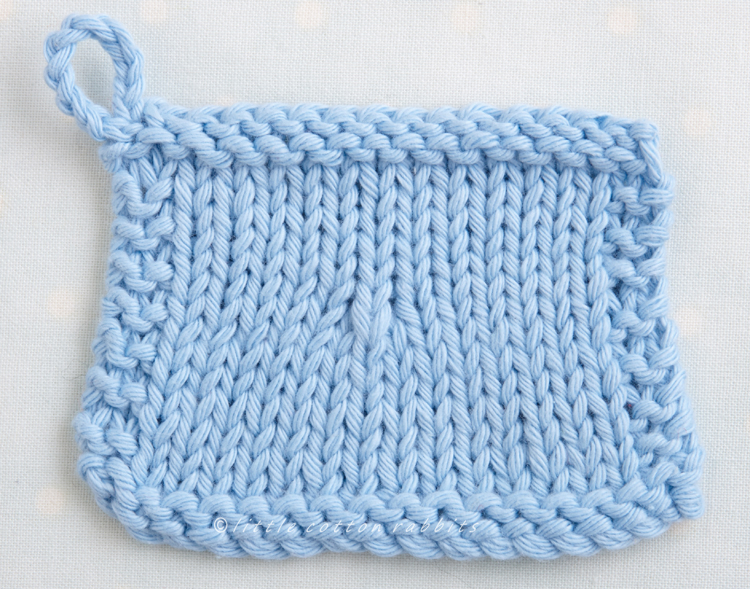
One of the โ€˜lifted increasesโ€™, this is an increase to use when what matters most is invisibility, and it works particularly well for knitted toys which are going to be firmly stuffed, as it creates a nice tight fabric without a gap for the stuffing to show through. Along with its symmetrical pair (KRL) this is the tightest increase method, giving the least visible result.

This is an increase best used on single colour stocking stitch. It does not work well with stripes as it distorts the two rows below the increase, so you need to be aware of that when planning the placement of any stripes.

. . . . . . . . . . . . . . . . . . . . . . . . . . . . . . . . . . . . . . . . . . . . . . . . . . . . . . . . . . . .

M1L: Make 1 Left:

Method: With the left hand needle pick up the connecting strand between the two needles from the front and knit into the back of the loop. If you find this too tight for your liking you can substitute M1A (make one away) which will give a looser increase.

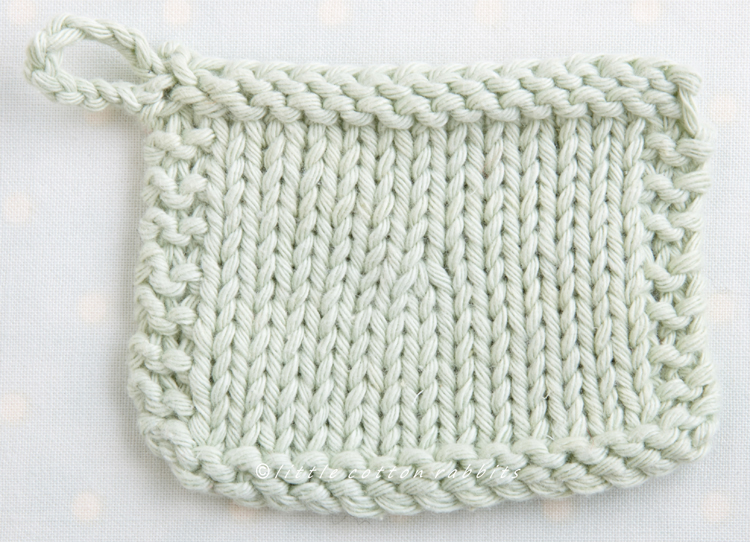
This is probably the most popular left leaning increase method and uses the strand that runs between two stitches that are already on the needle. If you are a tight knitter this can be quite fiddly to work, so it helps to use needles with very pointed tips. Because you are using the strand that connects two already worked stitches this can cause these stitches to be slightly distorted, as it takes a little length of yarn from them both. To minimise this try to use the narrow tip of the needle when working the increase rather than stretching the connecting strand by pulling it all the way on to the needle.

. . . . . . . . . . . . . . . . . . . . . . . . . . . . . . . . . . . . . . . . . . . . . . . . . . . . . . . . . . . .

M1A: Make 1 Away:

Method: Make a loop with the working yarn over the right needle tip so the tail is pointing backwards/away from you. On the following row you purl into this loop as normal in order to create a new stitch.

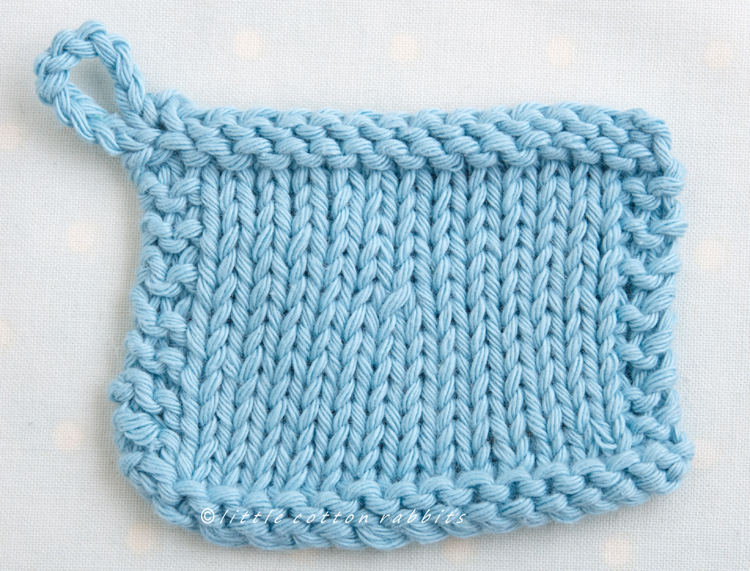
This creates a similar increase to M1L above but makes the increase one row later in the work and a little looser as the connecting strand between stitches is wrapped around the needle and so has more length to it. This results in a slightly more visible hole which can be minimised if you wrap the yarn tightly.

Its a nice increase to use on clothing as it stretches well and causes less distortion to the stitches around the increase.

. . . . . . . . . . . . . . . . . . . . . . . . . . . . . . . . . . . . . . . . . . . . . . . . . . . . . . . . . . . .


Right Leaning Increases:

KRL: Knit right Loop (also known as RLI: Right Lifted Increase):

Method: Knit into the right leg of the stitch one row below the next stitch on the left needle. Do this by inserting the tip of the right needle into the stitch from the back and bringing the loop up onto the left needle, then knit this loop as normal, so making an extra stitch.

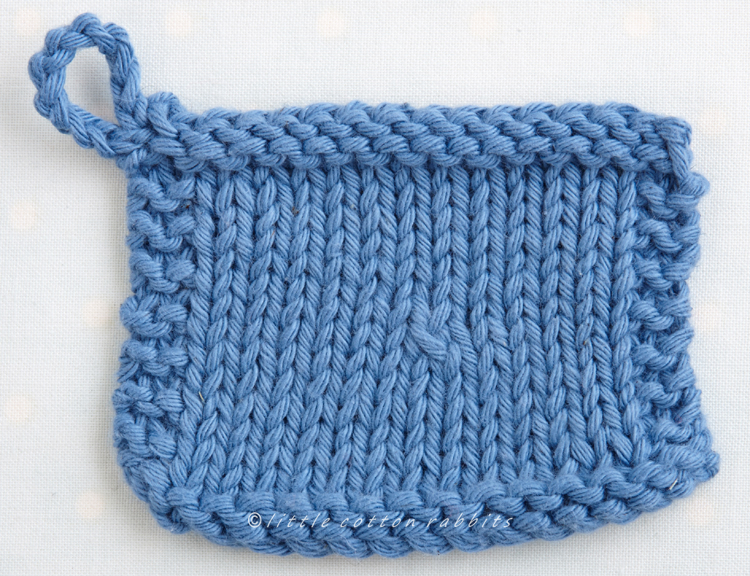
One of the โ€˜lifted increasesโ€™. This is an increase to use when what matters most is invisibility, and it works particularly well for knitted toys which are going to be firmly stuffed as it creates a nice tight fabric without a gap for the stuffing to show through. Along with itโ€™s symmetrical pair (KLL) this is the tightest increase method, giving the least visible result.

This is an increase best used on single colour stocking stitch. It does not work well with stripes as it distorts the two rows below the increase so you need to be aware of that when planning the placement of any stripes.

. . . . . . . . . . . . . . . . . . . . . . . . . . . . . . . . . . . . . . . . . . . . . . . . . . . . . . . . . . . .

M1R: Make 1 right:

Method: With the left hand needle pick up the connecting strand between the two needles from behind and knit into the front loop to create an extra stitch. If you find this too tight for your liking you can substitute M1T (make one towards) which will give a looser increase.

This is probably the most popular right leaning increase method and uses the strand that runs between two stitches that are already on the needle. If you are a tight knitter this can be quite fiddly to work, so it helps to use needles with very pointed tips. Because you are using the strand that connects two already worked stitches this can cause these stitches to be slightly distorted, as it takes a little length of yarn from them both. To minimise this try to use the narrow tip of the needle when working the increase rather than stretching the connecting strand by pulling it all the way on to the needle.

. . . . . . . . . . . . . . . . . . . . . . . . . . . . . . . . . . . . . . . . . . . . . . . . . . . . . . . . . . . .

M1T: Make 1 towards:

Method: Make a loop with the working yarn over the right needle tip so the tail is pointing forwards/towards you. Note: In order to get a neat finish you will need to purl into the back loop of this stitch on the following row.

This creates a similar increase to M1R above but makes the increase one row later in the work and a little looser as the connecting strand between stitches is wrapped around the needle and so has more length to it. This results in a slightly more visible hole which can be minimised if you wrap the yarn tightly.

Its a nice increase to use on clothing as it stretches well and causes less distortion to the stitches around the increase.

. . . . . . . . . . . . . . . . . . . . . . . . . . . . . . . . . . . . . . . . . . . . . . . . . . . . . . . . . . . .

Other Increases:

KFB: knit front and back:

This is probably the method of increasing that most people learn when they are first starting out with knitting, possibly because it is so simple. It does however make a very visible bar at the base of the increase stitch and so is not the best choice if you want a neat and tidy finished result to your work, (it is also know as a bar increase).

You work it by simply knitting into a stitch as normal and then before slipping that stitch from the left needle you knit into the stitch again, but this time through the back leg, so creating two stitches from one.

Because all of the other increase methods detailed here work by creating an increase stitch between two existing stitches it is not possible to simply substitute KFB without making adjustments. So if a pattern reads:

K2, KLL, K1, KLL (5 stitches)
then in order to use KFB instead of the KLL increase you would need to work:

K1, KFB, KFB (5 stitches).

The KFB increase does have itโ€™s uses as a decorative increase, and I do use it occasionally in my patterns for this reason.

. . . . . . . . . . . . . . . . . . . . . . . . . . . . . . . . . . . . . . . . . . . . . . . . . . . . . . . . . . . .

Other sources of information and tutorials:

There are lots of tutorials and videos available on the internet that demonstrate how to work these increase techniques. These can form an invaluable resource for any knitter who wants to hone their craft. Because itโ€™s not length of time that creates an experienced knitter, but the depth and breadth of their knitting skill base.

Here are a few of my favourite sites which have either good video or step by step tutorials for these increase methods (and many other knitting techniques too):

โ€ข Nimble Needles

โ€ข Very Pink Knits

โ€ข Knitting Help

โ€ข Purl Soho