My son is severely autistic and I wanted to share some of our experiences and things that we’ve found useful.
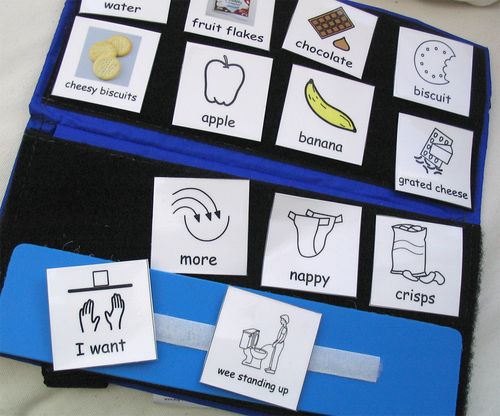
We were very lucky with our son in that we found out quite early on in his life that he was autistic – he was just 2 when diagnosed. Early diagnosis of autism can make such a difference to families – giving them the option of starting therapies and interventions early on in their child’s life, begin to adapt family life to the challenges and helping them avoid years of anguish and uncertainty. We started straight away with the PECs program and through that were able to give Toby the ability to begin communicating with us and lessen some of his frustrations.
Autism now affects 1 in 150 children and this year more children will be diagnosed with autism than with diabetes, cancer, & AIDS combined.
So what is it?
Autism is a ‘spectrum’ disorder which just means it affects each individual differently. Some children have a mild form and are able to speak, enjoy company and attend a mainstream school with a little extra support. Others are extreme and are withdrawn from the world, unable to speak or communicate with those that love them. Autism is a lifelong condition.
There are 3 key things that are common across the whole spectrum:
difficulty with social communication – some children have no speech at all, some can only echo speech they’ve heard, some understand and use speech well but are extremely literal – ‘I laughed my head off’ would be a confusing comment for them to interpret.
difficulty with social interaction – autistic people can find it very hard to form relationships and may lack awareness of what is viewed as appropriate behaviour – for instance personal space, touching strangers etc
difficulty with social imagination – an inability to understand what another person is thinking or feeling
Other autistic traits include:
Repetitive behaviours
For instance repeatedly watching the same video over and over for years or repeatedly lining up objects. Since the age of 3 my son’s only toy has been duplo lego and he will build a tower of 5 blocks, take it apart again and rebuild – repeating this action without a break for several hours at a time.
Many autistic people are extremely stressed by changes in routine.
Sensory sensitivity
This can affect any of the senses either by intensifying them (hypersensitivity) or by making them under-sensitive (hypo-sensitivity). Loud, sudden or particularly pitched noises can be unbearable. Clothing textures can also be a problem and many autistic children repeatedly strip off. I’ve found removing all clothing labels or wearing T shirts, pants and vests inside out helps Toby keep some of his clothes on.
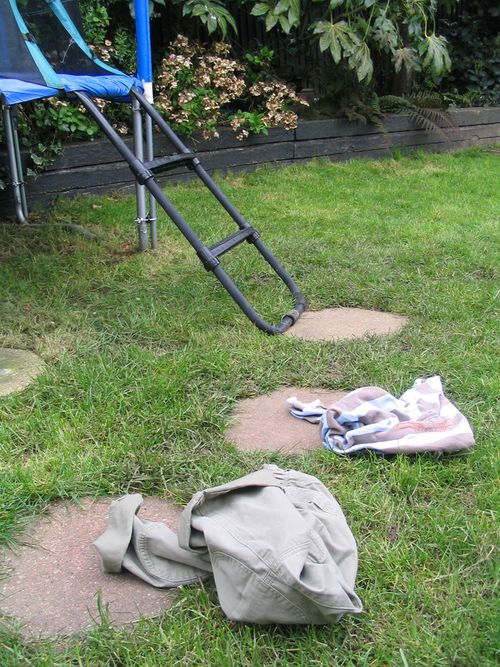
Many children with autism seek stimulation by rocking, hand flapping, flicking objects etc. Toby gets very excited by fast movement – such as cars along a busy road, rolling credits at the end of a film and will squeal and jump with delight. He also does a lot of head rocking.
An uncommon reaction to pain is also a factor, again either intensified or under-sensitive.
Poor sleep patterns
Difficulty going to sleep, frequent waking etc
Unusual eating behaviour
eating non-foods (shampoo, dirt, toothpaste etc), or only foods of one colour / shape, and extreme food fads are common.
Self injurous behavious
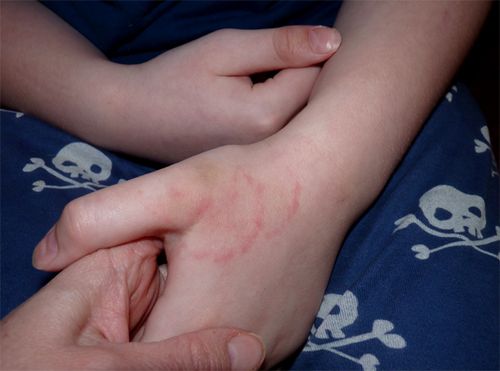
Hand biting and head banging against a wall are probably the most common. These are obviously extremely distressing for a parent to watch. Over the last ten years Toby’s hand have become very calloused and scarred and he is at constant risk of wound infection from his own saliva.

Some links:
As a parent looking for help the internet is a great resource. It does however give access to a huge and bewildering array of information and it is enormously time consuming to plough through it all. There are dietary interventions, behavioural therapies, communication strategies, research programmes and countless other avenues to investigate and interpret. Deciding where to start can be overwhelming.
I thought I’d share a couple of the UK sites that I’ve found useful through the last 5 years – it’s no where near a comprehensive list and since every child with autism is different it’s not going to cover much that everyone may need, but it’s a start and I will try to keep adding to it.
If you have a child with autism I wish you strength and courage – it’s not any easy journey but you are not alone. My best advice is to seek out other parents of autistic children. They will know exactly what you are going through and even if they have no solution just sharing your experiences will help enormously. Sharing your story with others in the same position has really helped for me – it just reminds me I’m not the only one going through this and helps me keep going.
Although Ian Brown’s son Walker is not autistic (he has a very rare condition called cardiofaciocutaneous syndrome (CFC)) there are many parallels between the experiences of his family and any family caring for any disabled child. His book, ‘The Boy In The Moon, A Father’s Search For His Disabled Son’ is an honest and enlightening account of life with his son. There’s a great interview you can listen to Ian Brown in conversation with Richard Fidler.
A few resources in the UK:
The National Autistic Society usually a first point of call with a very comprehensive list of information and links etc. There’s a full overview of information on autism for parents and carers, information on the latest research and a lot, lot more.
PECs (Picture Exchange Communication System) – We introduced this method when Toby was just 2 and it has given him the ability to ‘tell’ us a little of what he wants and needs. I believe it has helped him enormously and relieved a lot of the tantrums and melt downs caused by frustration. There are other ways of introducing communication (Makaton / signing) but this visual method seems particularly useful for children with autism and is universally understandable.
Thames Valley Adventure Play area
It’s hard to take an autistic child out in public and do ‘normal’ kid stuff as often understanding and tolerance are not forthcoming from others. People can be judgemental about the strange behaviours, tantrums and noises that autistic children often display. As a parent you do your best to ignore the stares and comments but they do sap your confidence and strength in taking your child out anywhere. The best thing about dedicated special need play areas is that everyone understands and that you don’t feel different as a family.
The Thomas Centre.
A great place for a holiday. The Thomas Centre in Lincolnshire, UK is a new contemporary barn development which provides 4 and 5 star luxury, self-catering holiday accommodation for families with communication impaired children and adults. Facilities include a pool, trampoline, indoor and outdoor play areas and it seems especially good as it’s small scale and everyone staying there is dealing with similar issues.
LDA Learning has lots of games and visual aids for kids with autism.
 little cotton rabbits