crafts & knitting · garden stuff

Hello

Hello and sorry to have been away so long – I've become a pattern-writing recluse again! The response to the bunny patterns completely overwhelmed me and it's been fantastic to see so many of them popping up on ravelry and to have so many lovely people come and join in conversations on the group. It's clear that lots of people would like to make their bunnies different clothes so I've put the animal patterns on the back burner for a bit and have been drawing charts and writing instructions for a wardrobe of dress designs.


Dresses

I'm almost done though I've gone a bit crossed eyed and brain addled from the process and of course I've fallen behind again with everything else that I should be doing, I am not terribly good at multi-tasking these days. I have made time in the evenings though to make a new cushion for the garden room. It matches the misty afghan that I made a while back which has found a new home on the sofa that was delivered last week.


Cushion


The garden room is getting lots of use now that there is something to sit on but I'll wait until all the furniture is delivered before taking more pictures. Outside is starting to come together nicely although there is still lots of paving and stuff to finish off. I've planted up one of my raised beds with carrots, lettuce, beetroot and french beans. Keeping the insect netting on just looked too scruffy so I've decided to try a bit of barrier planting instead.


Beds2

I've used mostly strong smelling herbs (hopefully to distract any unwanted munchers like carrot root fly) and have also planted some flowers to attract the pollinators and hoverflies whose larvae feed on aphids and leafhoppers. We will see how it develops and how my veggies grow this year without netting.


Bed

Well I hope to pop back soon with news of the dresses pattern and I was hoping to have another animal pattern ready before the start of the summer holidays but time is fast running out, this year has gone unbelievably quickly. I'm also hoping to finish of a bunch of bunnies soon, so will keep you posted on that if you're on the mailing list.

Hope you have a good week. Thanks for dropping in x


garden stuff · general stuff

garden room

Well, half term last week was a bit of a wash out really. The first half of the week was wet and windy and in the second half we all came down with stinking colds. Still, it was impossible to feel downhearted because we now have this at the end of the garden ๐Ÿ™‚


Garden house

It is everything we had hoped it would be, and more. Toby adores it and has been in and out of it constantly, enjoying exploring every inch of it.


Toby explore

In fact he was in and out of it even before it was finished.


Tobyexplore

He was fascinated by the activity in the garden when it was being built. And what a mammoth amount of activity there was! The guys from Planet Design were absolutely and completely awesome. They worked hard through all weathers, right through the days of
non-stop heavy rain and even a hailstorm didn't put a stop to the
construction.


Working

They put in three hard weeks of back breaking work but always kept their good humour and they were a pleasure to have around. To be honest I missed them a bit once they'd packed up all of their tools and finished and I think Toby did too. He loved watching them working while he bounced on the trampoline and they were so friendly and kind with him (and very tolerant of his attempts to join in!). We're so thankful to them for building us the room of our dreams.


Lights


There is no way though that this would ever have been possible without the amazing and humbling generosity of our family and friends (and friends of friends). Two and a half years ago H and I were balancing on the brink of despair. At the time Toby was having frequent and extreme meltdowns and I was regularly driving him around in the middle of the night just to get him out of the house so that Amy could get some sleep. We used to talk about things that might make the situation more bearable and ways we could cope long term (because we know that similar periods of behaviour are more than likely in Toby's future). We imagined having a space where one of us could take Toby when things were hard so that the rest of the family could get some peace or where Amy could go to concentrate out of earshot of Toby if he was in the house. The costs involved put it out of the question though and it stayed a distant dream until H's Mum and Dad decided they would like to ask for donations rather than presents for their Golden Wedding anniversary party. All of the guests that came to join them in celebrating were so very generous and the Toby Respite Room fund started growing. Extended family and friends have continued contributing both their own money and money they have raised through sponsored events, runs and raffles and we have been constantly moved by how kind and supportive everyone has been.

We were so very touched when the artist Jim Crouch donated one of his wonderful paintings and the proceeds from the sale of that and of several limited edition prints went into the fund. Both of our sets of parents have been incredibly generous too.

It is impossible to find the right words to express how deeply grateful we are to everyone whose kind heartedness has made building this room possible. It makes the future with Toby a bit less scary as it gives us options in times of stress. We now have a separate space to take him to when he needs calm and quiet and refuge that is quiet and peaceful and 'away' for the rest of the family to use when needed. At the moment there is still a fair bit to do such as paving, planting and the like and inside there is only a beanbag at the moment as we're waiting on furniture. Once it's all furnished and bedded in I'll take some more pictures.


Inside

Before I go I'm going to give the guys from Planet Design another mention because so often having work like this done on your home can be such a stressful thing (especially with a child like Toby around). But it was clear from the outset that they were completely committed to building us a perfect room, finished exactly on schedule and on budget and this took away all of the stress for us. So thanks Lee, Luke, James, Troy and Tony for building us such a wonderful, hassle free room.

crafts & knitting · knitting tips

Knitting tips: Fair Isle/stranded colourwork

During writing up the first of my animal patterns it’s been hard to know just how much detail to go into. I didn’t want the patterns to only cover the written knitting instructions with a few lines about assembling the toy almost as an afterthought. Instead I wanted them to include as much detail of the finishing process as possible because I think that is a hugely important part of making them. But there is a limit to what you can pack in to a pattern and so I thought I’d write up some extra notes here on the blog that can be referred to if needed. These extra posts will be categorised under ‘knitting tips’ and the first of these ‘knitting tips’ posts is about Fair Isle/stranded colourwork knitting.

Through chatting with knitting friends it seems that stranded knitting is generally thought to be quite difficult. It really isn’t though. It is a little bit fiddly and takes a little patience and practice to get right but it is perfectly achievable for anyone who can already knit and purl.

There are tons of instructions, diagrams and videos out there on the internet and plenty of books published on the subject and I’m not intending to cover every conceivable aspect of Fair Isle. Instead I’d like to write up notes on the way that I work stranded / Fair Isle and
some tips I’ve learnt along the way to iron out some of the difficulties that are commonly experienced. It is worth pointing out that I knit English style, with both colours in my right hand, so my notes below are written for that way of working. If you knit continental style with a colour in either hand then check out this video or try a search on You Tube as there are lots of other good ones.

Colour dominance:

When you knit a design with two colours you are constantly switching between them and it is really important to be consistent with the order in which you use them. By this I mean which yarn is stranded over the top of the other at the back of the work when it is not the colour being knitted with at the time. It is generally accepted that the yarn stranded beneath will be the more dominant colour in the design.

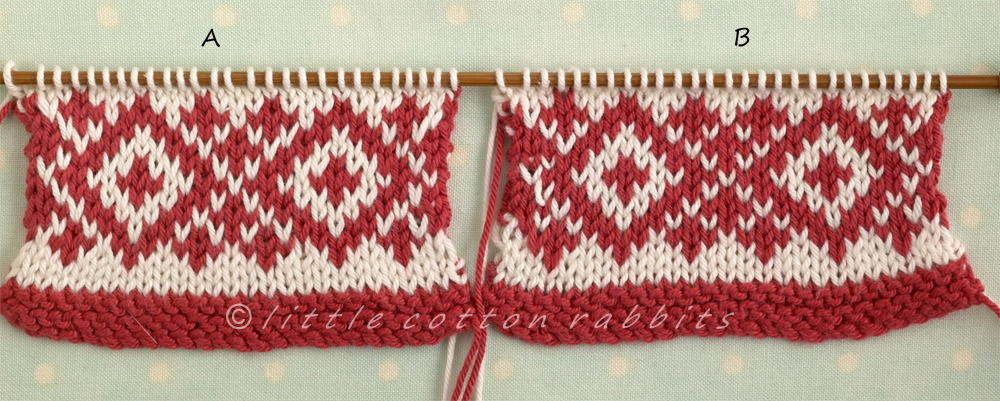
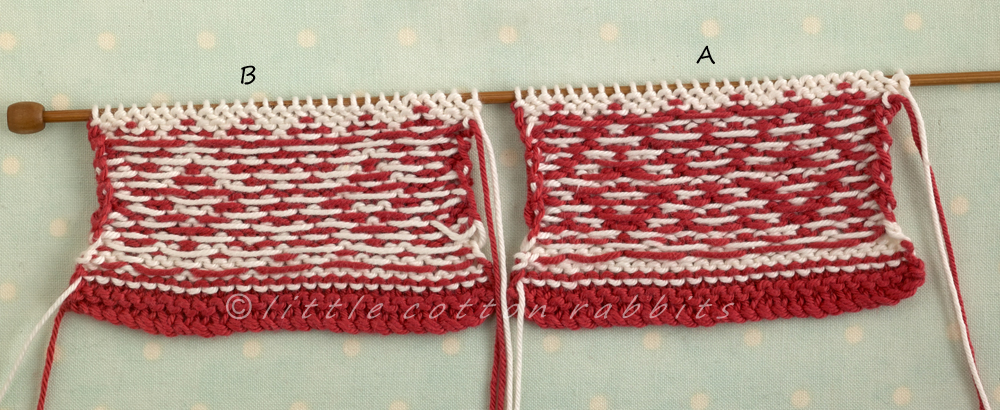
For example, the two samples below are knitted in the same colours and to the same pattern. The only difference is that in sample A the cream yarn is stranded below the red yarn and in sample B the red yarn is stranded below the cream.
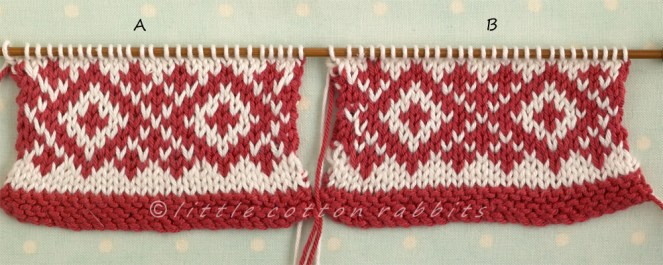
Because of this difference I usually strand the accent colour below the main background colour (as in sample B above). You can choose either way but the most important thing is to be consistent if you want your finished piece to look neat and even.

There is a lovely post here about the perils of ignoring yarn dominance!

Catching up the yarn at the back of the work:

When there are gaps between sections of a pattern worked in the same colour the strands of un-worked yarn that travel across the back of the work are called floats.

It is generally suggested that floats should not strand across more than 7 stitches but my preference is for no more than 4 stitches. If I have to strand yarn across 5 or more stitches I always catch up my floats and usually in the centre of the span.

Lots of people only catch up their floats with a single wrap but I have found that my knitting looks much neater with a double catch up.

How to do double catch ups:

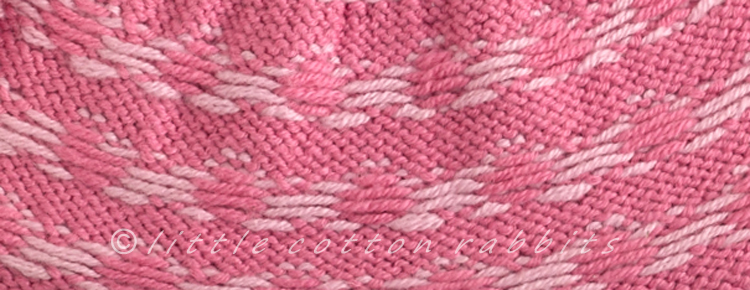
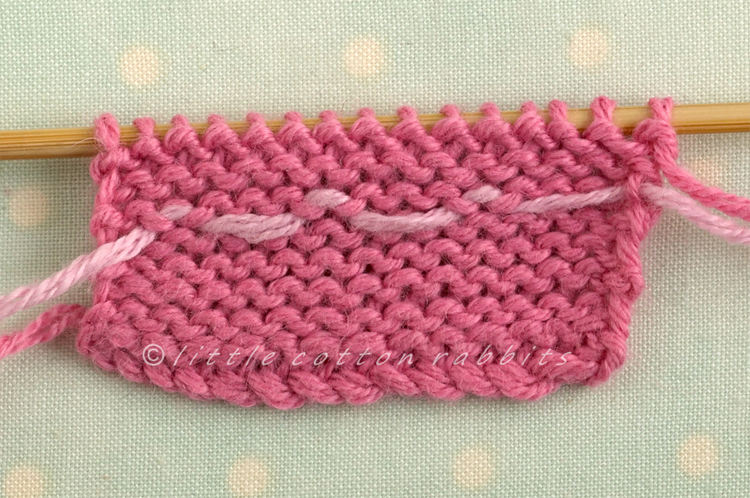
In this sample the darker pink is the main colour and the lighter pink is the accent colour.

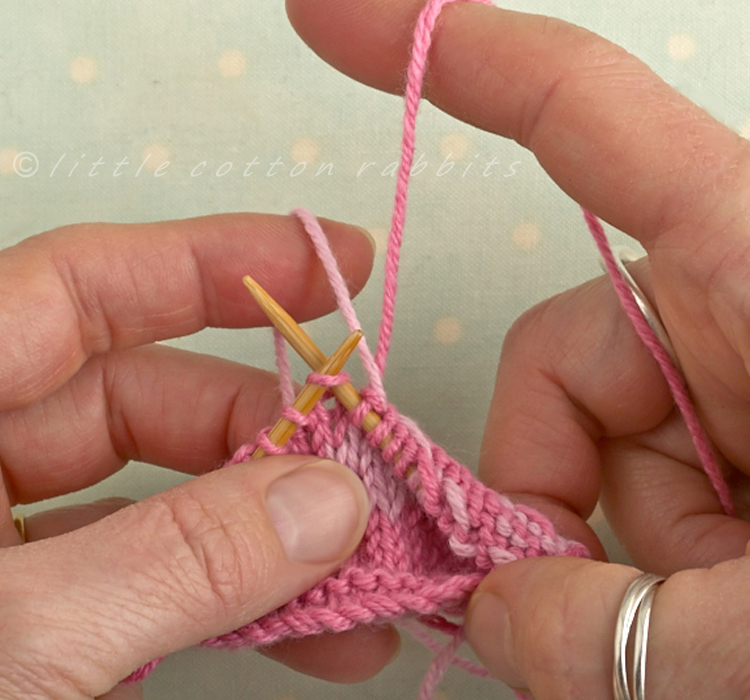
Here I need to strand the accent yarn that I’m using for polka-dots across the back of 6 stitches of the main colour. Because it is the accent colour I am stranding it below the main colour (see above note on colour dominance). To catch up a long float first bring the accent colour from underneath the main colour.

Then work the next stitch with the main colour, so catching the un-worked accent yarn up with the loop between the stitches worked in the main colour. Then take the accent colour over the top of the main colour before working the next stitch, so catching the un-worked accent yarn a second time in a downwards direction.

At this point it is good practice to gently tighten the main colour stitch you’ve just worked as it can become a little loose with the extra yarn caught through it. It is important not to tighten the accent colour strand as this will cause the work to pucker and become uneven. Keep the strands of accent colour caught up at the back loose enough to stretch with the work.

Here’s how it looks from the back. You can see the floats of accent yarn are caught up each time by two loops of the main colour yarn.

This technique can be used on both a knit or purl row.

Other rules that I always apply to fair-isle/stranded colourwork

  • Try not to catch up your floats in exactly the same place on consecutive rows as this can lead to banding on the front of the work.
  • Always take any strands of un-worked colours right to the end of each row and catch them up on the edge by twisting them with the yarn currently being used. If you don’t do this you will end up with gaps in your knitting where the stranded yarn pulls at the fabric.
  • If you are working sections of a pattern that don’t include one of the colours, run this un-worked colour up the side of the work by twisting it with the main colour at the end of rows rather than cutting and re-attaching it each time it is needed.
  • If you are mattress seaming your piece try to sew through the strands of both yarns when they are both present on the same row rather than just the main colour as this will give a much neater and more robust seam.
  • You can mix different brands of yarn but stick to the same weight category and yarn composition – for instance don’t use a 4ply cotton yarn with a 4ply wool yarn as they will have different stretching properties.

These notes are not intended as an exhaustive guide but just a mention of the techniques that I like to use. A search on google or You Tube will give you many more tips and techniques if you want to know more.

If you have an aspect of knitting that you’d like me to write about in more detail please let me know and I’ll do my best to help.

Thanks x